A handmade shop does not reorder from a supplier. The maker throws the pot, sews the bag, pours the candle, and that takes hours that have to fit around everything else. Sold-out listings are normal, and so is uncertainty about when the next batch will exist. Back-in-stock alerts for a handmade shop have to respect that reality: they should capture demand without making promises the maker cannot keep. This post is about how production limits change the way you set up and word alerts, and we avoid invented statistics because we do not have reliable data for this niche.
Capacity Is the Real Inventory
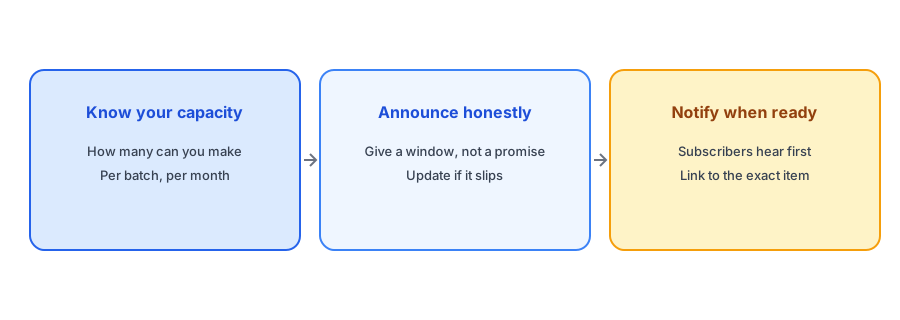
For most stores, stock is a number in a warehouse. For a maker, stock is time. A batch of twelve may take a week, and a hundred people on the waitlist does not make it faster. It is worth knowing roughly how many pieces you can make before you invite signups, and being comfortable telling people how many are likely in the next run. A long waitlist is useful information about demand, but it can also create pressure. Our post on running a fair waitlist for limited units helps you decide who hears first when demand outstrips supply.
Give a Window, Not a Date You Might Miss
The riskiest thing a maker can do is promise a specific restock date and then miss it. Shoppers remember. A window such as "late spring" or "the next batch is planned for the first half of the month" is more honest, and if it slips you can update people instead of apologizing for a broken promise. Say what the alert will mean: you will email when the item is ready to buy, not when it is started. Our replies for "when will it be back in stock?" include wording for uncertain timing.
Made to Order Is Not the Same as Back in Stock
Some makers sell a made-to-order version that ships weeks after purchase, alongside ready-to-ship pieces. These are different offers and deserve different handling. A restock alert is for ready-to-ship stock returning; a made-to-order option is closer to a preorder with a lead time. If you offer both, make sure shoppers can tell which they are buying. Our post on back-in-stock alerts versus preorder apps explains the difference and when each fits.
Capture demand without overpromising. Griffin adds Notify Me to every sold-out item in your shop.
Install Griffin on ShopifyOne-of-a-Kind Pieces and Variations
Handmade products vary: a slightly different glaze, a different fabric from the same bolt. If you restock a design, the new batch may not match the old one exactly. Tell subscribers so, since some collectors want the same look and others do not mind. If a piece was truly one of one, it is not coming back, and the Notify Me option should not suggest otherwise; the same honesty applies to one-off jewelry pieces. For items you make again, you can learn which pieces to prioritize by reading how to track customer demand for out-of-stock products.
Keep the Relationship Personal
Handmade shoppers often buy because of the person behind the shop. A restock email in your own voice, with a line about what you have been making, fits the brand better than a generic template. Keep it short and put the link to the exact item front and center.
Using Signups to Decide What to Make Next
A maker has limited hours, so the list of people waiting is a valuable guide to what to make. A design with many signups is a strong candidate for the next run, while one with few may be better left as an occasional piece. Compare the numbers across items, and across colors or sizes of the same design, before you commit materials. Be careful not to over-read a small list, and remember that a long list does not oblige you to make more than you can sustain. If demand regularly exceeds what you can produce, you may prefer to open the waitlist in rounds, capped to the next batch, so nobody waits indefinitely on a promise you cannot meet.
A Practical Checklist
- Decide how many pieces each batch can cover before you promote the waitlist.
- Share a timing window, and update subscribers if it changes.
- Keep made-to-order and ready-to-ship offers clearly separate.
- Tell subscribers when a new batch may look slightly different.
- Write the restock email in your own voice with a direct link to the item.
FAQ
How do restock alerts work for handmade products?
Shoppers sign up on a sold-out item and are emailed when it returns to stock. For makers, that means when the next batch is ready to buy.
Should I give a restock date?
Give a window you are confident in rather than a precise date, and update subscribers if it slips.
Is a made-to-order option the same as a restock alert?
No. A restock alert is for ready-to-ship stock returning, while made-to-order is closer to a preorder with a lead time.
What if the next batch looks different?
Say so in the email. Some customers want an exact match and others enjoy the variation.
The Bottom Line
For makers, the restock alert has to fit real production limits: know your capacity, share honest windows and keep your voice personal. Griffin is a Shopify back-in-stock app you can install from the Shopify App Store, free to start.