A supplement customer who runs out of their regular product is a different shopper than someone browsing for the first time. They already know exactly what they want, they've likely built it into a routine, and if it isn't there when they go to reorder, they don't spend long deciding what to do next. Supplement merchants are paying more attention to back-in-stock alerts because they are realizing a generic"sold out" page is a bad fit for how their repeat customers actually behave.
Wellness and supplement stores run on repeat purchases more than almost any other Shopify category, which means an out-of-stock supplement isn't just a missed sale, it's a subscriber who was already converted once and is now free to reorder the same ingredient from whoever has it in stock.
Why Supplement Restocks Don't Work Like Apparel Restocks
Most back-in-stock advice is written with apparel or general retail in mind, where restocking is mostly a matter of reordering inventory from a supplier. Supplements run on a slower, more constrained cycle. A batch has to be manufactured, and depending on the product, it may need lab testing or compliance checks before it can legally ship. That means the gap between "sold out" and "back in stock" is often measured in weeks, not days, and it isn't fully in the merchant's control.
This is exactly why a reliable notification for out-of-stock supplements matters more here than in faster-moving categories. Apparel customers checking back manually might get lucky within a day or two. Supplement customers checking back manually are far more likely to run out completely and start looking elsewhere before the batch clears testing.
The Formula Discontinuation Risk
There's a wrinkle specific to this category: not every "sold out" supplement is actually restocking. Ingredient sourcing changes, supplier discontinuations, and reformulations happen more often in wellness than in most other verticals. A back-in-stock alert that quietly promises a restock that isn't coming does real damage to trust, especially with a subscriber who already reorganized their routine around waiting for it.
The practical fix is to treat "temporarily out of stock" and "discontinued or reformulated" as two different states, not one. A supplement restock notification should only go out when a restock is genuinely expected. If a formula is being retired or changed, that calls for a different message pointing the subscriber to the closest current product, not silence and not a vague "we'll let you know."
Matching Alerts to the Subscribe-and-Reorder Cycle
The other thing that makes this category distinct is timing. A supplement with a 30-day dosage has a fairly predictable reorder window, and the moment a returning subscriber hits a sold-out page in that window is the highest-intent moment a store will ever get with that customer.
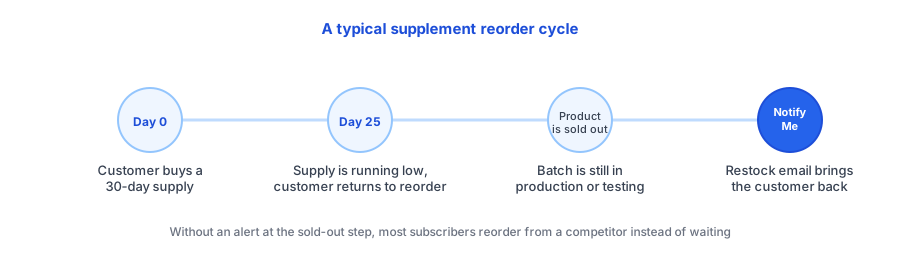
A "Notify Me" widget on the sold-out page catches exactly that moment. The subscriber doesn't have to remember to check back manually during a batch delay, and the store doesn't have to guess when to re-engage them. The email goes out the moment inventory clears, which for a subscriber already mid-routine is often enough on its own to win the reorder back.
See how a variant-aware "Notify Me" widget looks on your supplement or wellness store, free to start.
Install Griffin on ShopifyWhat to Look for in a Wellness Brand Shopify App
Not every restock tool fits this category well. A few things matter more for supplements and wellness products than they do elsewhere:
- Flavor, dosage, and pack-size variants tracked separately. A subscriber on the unflavored 60-count won't reorder just because the flavored 30-count restocked. Notifications need to match the exact SKU someone was buying.
- No false restock promises. A wellness brand shopify app should make it easy to leave a product's notify-me option off, or redirect it, when a formula is genuinely discontinued rather than temporarily out.
- Fast email delivery once inventory clears. Given how narrow the reorder window can be, a same-moment notification matters more here than in categories where customers browse more casually.
- No theme code editing. Compliance and label changes already add enough operational overhead. The restock widget itself shouldn't require developer time to install or maintain.
FAQ
Do supplement customers actually wait for a restock, or do they switch brands?
Many will wait a few days if they're told a restock is coming, since switching means researching a new formula and dosage from scratch. But that patience runs out fast without a notification, and most subscribers reorder from a competitor rather than checking back manually.
What if a supplement gets reformulated or discontinued instead of restocked?
A back-in-stock alert shouldn't promise a restock that isn't coming. If a formula is discontinued or changed, that needs a different message, ideally pointing subscribers to the closest current product, rather than staying silent or sending a vague notification.
Does back-in-stock tracking need to be variant-specific for supplements?
Yes. Flavor, dosage strength, and pack size are typically separate variants, and a subscriber on the unflavored 60-count won't reorder just because the flavored 30-count is back. Notifications should match the exact variant someone was buying.
Is email enough for supplement restock alerts, or do I need SMS?
Email covers most of the value here since it's free to send and subscribers already expect a reorder reminder in their inbox. SMS can help later for high-frequency reorder categories, but it isn't required to see results from restock alerts.
The Bottom Line
Supplement and wellness customers are some of the most loyal repeat buyers a Shopify store can have, right up until a sold-out page gives them a reason to look elsewhere. Because restock timing here depends on production and compliance rather than a quick reorder from a supplier, a back-in-stock alert isn't a nice-to-have, it's what keeps a subscriber's routine pointed at your store instead of a competitor's during the gap.
If you're setting this up for the first time, Griffin installs as a lightweight app block with variant-aware notify-me subscriptions, no theme code edits required. If a product line includes items that won't be restocked in the same form, it's also worth reading Back-in-Stock Notifications vs Waitlists to decide which flow fits each one. Install Griffin on the Shopify App Store to get started free.