A handful of back-in-stock apps market web push as a third notification channel, alongside email and SMS, with a pitch that sounds hard to argue with: a shopper subscribes with a single click, no email address or phone number required, and gets an instant browser notification the moment a product restocks. It's a real capability, and the low-friction signup is genuine. What most of those marketing pages leave out is how often that subscription silently stops working, through no fault of the shopper or the merchant.
What Web Push Actually Is
Browser notification back in stock alerts work through a permission the shopper's browser grants a website, not through any personal contact info. When a shopper clicks "Allow" on the notification prompt, the browser creates a subscription tied to that specific browser, on that specific device. From then on, the site can push a notification that appears even if the store isn't open in a tab, similar to a mobile app notification but running through the browser instead.
That's the appeal in one sentence: zero data collection friction. No form to fill out, no email to type, no confirmation click needed the way double opt-in requires for email. Just one permission prompt.
Where It Quietly Breaks
The subscription that makes web push frictionless to set up is also what makes it fragile to keep. Because it's tied to one browser on one device rather than to a person, several ordinary things can silently end it, with no signal to the merchant that a subscriber was lost:
- Clearing site data or cookies wipes the browser's stored subscription entirely.
- Switching browsers, say from Chrome to Safari, or getting a new phone or laptop, means starting over with a fresh subscription, since nothing carries the old one over.
- Revoking notification permission, whether on purpose or by accident while clearing out notification clutter, ends the subscription immediately.
- Mobile browser support varies by browser and operating system, so coverage isn't as consistent across devices as it is with email.
None of this is a defect in any particular shopify push notification app. It's how the underlying browser permission model works everywhere. The result is a channel that looks like a clean win on signup day and quietly loses subscribers in the background afterward, in a way neither the shopper nor the merchant can see happening.
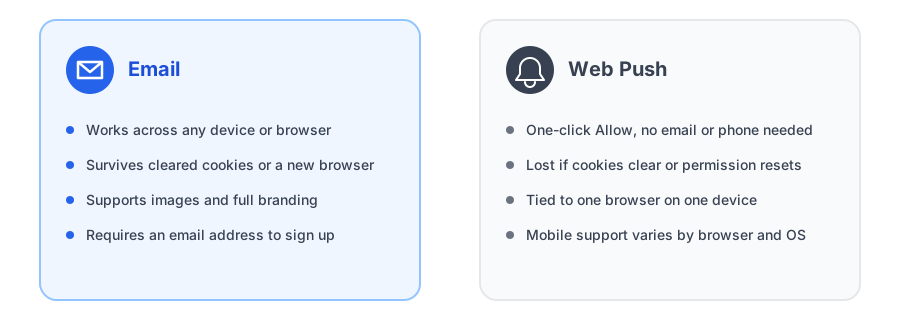
Email vs Push Notifications: Which Actually Fits a Restock
A back-in-stock alert isn't sent the moment someone subscribes, it's sent whenever the item happens to come back, which could be days or months later. That gap matters a lot when comparing email and push notifications for your store. Email survives that gap intact: the address doesn't expire, doesn't depend on the shopper's browser cache staying untouched, and works identically whether the shopper opens it from their laptop, phone, or a completely different device than the one they subscribed on.
Push has no such guarantee across a long gap. A subscriber who signed up in June on a phone they've since replaced, or a laptop they've since wiped, is a subscriber the merchant still thinks they have, right up until the notification silently goes nowhere.
See why Griffin keeps back-in-stock alerts simple: one reliable, branded email, no extra channel to maintain.
Install Griffin on ShopifyWhere Push Still Makes Sense
None of this makes web push useless. It can be a reasonable supplemental channel for a store with high repeat traffic from shoppers who browse on the same device regularly, where the odds of a subscription surviving until restock are better than average. It's weaker as a primary or only channel, since a merchant relying solely on push has no way to know how many of their "subscribers" can actually still receive anything by the time a product comes back.
That's also why Griffin doesn't bolt on push the way some competitors do. The same reasoning that keeps SMS out of the product applies here: most merchants get more reliable value from one channel that works consistently than from an additional one that looks impressive in a feature list but degrades quietly over time.
FAQ
What is a web push notification for back-in-stock alerts?
It's a browser-level notification a shopper agrees to receive by clicking Allow on a permission prompt, rather than by giving an email address or phone number. The notification can appear even when the store isn't open in a tab.
Why do web push subscriptions stop working?
The subscription is tied to one browser on one device. Clearing site data, switching to a different browser, getting a new device, or revoking notification permission all break it, and there's no way for the merchant to know it happened.
Is web push better than email for back-in-stock alerts?
Push has a lower-friction signup since no email or phone number is required. Email is more durable since it survives cleared browser data and works the same across every device, which matters more for a notification a shopper might not see for days or weeks after signing up.
Does Griffin support web push notifications?
No. Griffin is intentionally email-first, the same reasoning that keeps SMS out of the MVP: most merchants get the bulk of the value from a fast, reliable, branded email without adding another channel to maintain.
The Bottom Line
Web push earns its low-friction signup honestly, but that same design is what makes it quietly lossy over the days or weeks between a signup and an actual restock. For most Shopify stores, a durable channel that doesn't depend on a browser cache staying intact still does more of the real work than an extra channel that looks appealing on a feature comparison page.
If you're comparing notification channels more broadly, our look at email vs SMS back-in-stock alerts covers the same trade-off from a different angle. Griffin keeps things simple with one reliable, branded restock email. Install Griffin on the Shopify App Store to see it on your own store, free to start.