Open nearly any competitor back-in-stock app's marketing page and SMS gets top billing: faster opens, higher engagement, a more "urgent" feel than an inbox. What's missing from most of those pages is a vendor-neutral look at what SMS actually costs to run and set up compared to email, for a typical small Shopify store rather than an enterprise brand with a dedicated texting budget.
Both channels can work. The right one for email vs sms back in stock alerts depends less on which has the flashier stat and more on your restock cadence, your customer base, and how much complexity you're willing to take on for a marginal speed advantage.
Why SMS Back-in-Stock Alerts Look Appealing on Paper
The case for SMS is straightforward: text messages tend to get opened and read faster than email, since they land on a lock screen instead of competing with a crowded inbox. For a genuinely urgent moment, like a small batch restock that will sell out again in minutes, that speed can matter. It also feels more immediate to the shopper, closer to a real-time alert than a marketing email.
That's a real advantage in the right situation. The problem is that most competitor pages stop there, without walking through what it actually takes to run SMS restock notifications, or being honest about which stores actually need that speed.
The Real Costs and Setup Complexity Behind Shopify SMS Alerts Cost
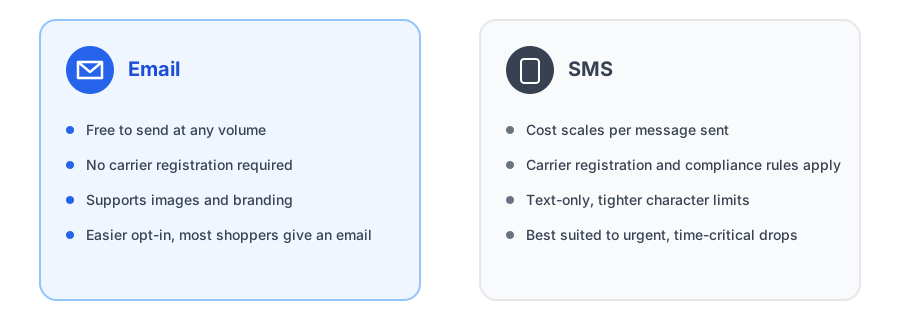
Shopify sms alerts cost adds up in ways email simply doesn't. Email is free to send at any volume once a merchant has a tool in place. SMS is billed per message, so a restock alert that reaches a few thousand subscribers carries a direct, recurring cost that scales with list size, not a one-time setup fee.
There's also a compliance layer that doesn't exist for email. In the US, SMS marketing is subject to carrier registration requirements and stricter consent rules than email, which means real setup time and ongoing administrative overhead before a single text goes out. Phone numbers are also harder to collect than email addresses; shoppers are generally more willing to hand over an email at checkout than a phone number for marketing texts, so an SMS list often ends up smaller than an email list built from the same traffic.
When Back in Stock Email Marketing Is Simply Enough
For most Shopify stores restocking standard products on a normal cycle, back in stock email marketing already covers the job well. A restock isn't usually a countdown measured in seconds, so the marginal speed advantage of SMS rarely changes whether a shopper completes the purchase. Email also supports product images and real branding in a way a text message can't, which matters for a restock alert meant to look like it belongs to your store.
This is also why Griffin ships email-first rather than bolting on SMS as a checkbox feature. Most merchants get the bulk of the value from a fast, reliable, branded email the moment inventory updates, without taking on carrier compliance or per-message costs before they've even confirmed restock alerts are worth investing in further.
See how a fast, branded restock email looks on your own store, free to start, no carrier registration required.
Install Griffin on ShopifyWhen SMS Is Worth Adding
SMS earns its cost in narrower situations than the marketing pages suggest. It's worth considering for genuinely hype-driven categories, like the size- and colorway-specific restocks common in streetwear and sneaker drops, where a restock really can sell out again within minutes and every second of delay matters. It can also help for a customer base that's demonstrably more responsive to text than email, though that's worth confirming with your own data rather than assuming it.
Outside of those cases, the added cost and compliance overhead usually isn't buying much beyond what email already delivers. Some stores do run both, using SMS only for their highest-urgency drops and email for everything else, which captures the upside without paying SMS rates on every restock.
FAQ
Does SMS convert better than email for back-in-stock alerts?
SMS is typically opened faster since it doesn't compete with an inbox, which can help for extremely time-sensitive drops. For a normal restock cycle, email converts well on its own since the shopper isn't racing a countdown, and it costs nothing extra to send.
Is SMS worth the extra cost for a small Shopify store?
For most small stores restocking standard products on a normal cycle, the per-message cost and compliance overhead of SMS outweigh the benefit. It's more worth it for hype-driven categories where a restock genuinely sells out again within minutes.
Do I need special compliance for back-in-stock text messages?
In the US, SMS marketing is subject to carrier registration and consent rules that email doesn't require. Email back-in-stock alerts still need proper opt-in, such as double opt-in, but avoid the carrier registration layer entirely.
Can I use both email and SMS for restock alerts?
Yes, and some stores do, using SMS for the highest-urgency drops and email for everything else. Many stores find email alone covers the large majority of restock scenarios without the added cost and setup of a second channel.
The Bottom Line
SMS isn't a scam and it isn't a must-have either; it's a channel with a real cost and compliance overhead that only pays off for a narrower set of genuinely time-critical restocks than competitor marketing pages tend to admit. For most Shopify stores on a normal restock cadence, a fast, branded, free-to-send email already does the job a restock alert needs to do.
If you want to see what that looks like before deciding whether SMS is worth adding later, Griffin installs as a lightweight, email-first app block with no theme code edits and no carrier registration to manage. It's also worth checking how back-in-stock app pricing works if cost is the deciding factor for your store. Install Griffin on the Shopify App Store to get started free.