A restock alert feels like the same tool no matter what you sell: a shopper misses out, signs up, gets an email when it's back. For collectibles stores, that framing misses something specific to the category. A sold-out trading card box, a mystery figure line, or a numbered limited release doesn't behave like a normal product running low on inventory, and setting up alerts the same way you would for a standard apparel restock leaves real nuance on the table.
Why Collectible Restocks Aren't Quite Like a Streetwear Drop
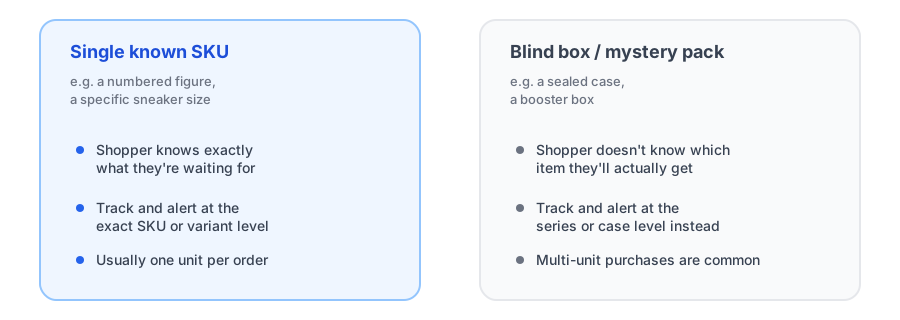
Sneaker and streetwear drops sell out fast, but a shopper there usually knows exactly what they want: this style, this size, this colorway. Collectibles break that assumption constantly. Blind box lines, trading card boosters, and mystery packs are sold sealed, which means the shopper signing up for a toy restock alert has no way to know which specific character or card they'll actually get. The thing they're really waiting for isn't one SKU, it's the chance to pull from a given series or wave again.
Buying behavior differs too. A streetwear shopper typically wants one pair in one size. A collector chasing a specific chase figure or building out a full set often wants several units from the same restock, which changes how a merchant should think about quantity limits and demand signals compared to a single-unit apparel purchase.
The Bot and Reseller Problem Changes What an Alert Is Actually For
Collectible drops are one of the most heavily targeted categories for bots and resellers, given how far resale prices can run above retail for a genuinely scarce release. It's worth being honest about what a trading card restock notification can and can't do here: it isn't going to out-race a dedicated bot on raw speed. What it still does reliably is recover demand from the much larger group of real collectors who can't refresh a product page every few minutes the way automated tools do. An alert that fires the moment inventory updates gives that audience a fighting chance they wouldn't otherwise have.
This is also why per-customer purchase limits show up so often in this category specifically. Capping quantity at checkout doesn't replace a back-in-stock alert, it works alongside one, limiting how much of a scarce restock a single buyer (or a single bot account) can absorb.
Set up series-level restock alerts for your collectible drops, live in minutes.
Install Griffin on ShopifyWhat to Track When the "Variant" Is a Mystery
For sealed blind box or booster product lines, track and alert at the series or case level, since that's the actual unit being restocked, not the individual character or card inside it. For collectibles sold as a known, specific item, a numbered figure, a particular signed piece, a single named product, treat it like any other single-SKU restock and track it at that level, the same way a streetwear drop tracks size and colorway. The right level of tracking depends entirely on whether the shopper can actually choose what they're getting.
Limited Edition vs. Reprinted: Set Expectations Clearly
A limited edition drop back in stock promise only works if it's true. Some collectible releases are explicitly numbered and final, a run of 500 that will never be made again, while others, especially core trading card products and ongoing toy lines, genuinely do get restocked over months. Letting a back-in-stock signup imply a restock on something that's truly one-and-done sets up the same trust problem as sending a false restock alert for a discontinued product elsewhere in a catalog. Being upfront about which releases are final and which are likely to come back keeps the signal meaningful.
FAQ
Should I track back-in-stock alerts per character in a blind box line?
Usually not directly, since a shopper can't choose which figure comes out of a sealed box. Track and alert at the series or case level instead, since that's the actual thing being restocked.
Do back-in-stock alerts even help against bots and resellers?
Yes, though not by out-racing dedicated bots on raw speed. They still recover real demand from collectors who can't monitor a product page around the clock the way automated tools can.
Should I cap how many units a customer can buy on a restock?
Many collectible sellers do, specifically to limit bulk buying by resellers. That's a separate inventory-allocation decision from the back-in-stock alert itself, and the two work well together.
What if my limited edition set says it won't be reprinted?
Don't let a back-in-stock signup imply it will restock. Be explicit that a true limited edition is final, and reserve restock alerts for lines you genuinely expect to bring back.
The Bottom Line
Collectibles sell out as fast as any hype streetwear drop, but what a shopper is waiting for, and how much of it they want, looks different once mystery packaging and reseller pressure enter the picture. Tracking demand at the right level, series for blind boxes, SKU for known items, and being honest about what's truly final versus what's likely to come back keeps restock alerts doing real work in a category built on scarcity.
If you're weighing restock alerts against a true one-time release, Back-in-Stock Notifications vs Waitlists covers how to split that decision. Griffin installs as a lightweight app block with variant-aware notify-me subscriptions, no theme code edits required. Install Griffin on the Shopify App Store to get it live before your next restock.