Search "back in stock app" in the Shopify App Store and the pricing spread is confusing: some apps are free, some start at $9/mo, others jump straight to $30-50/mo before you've sent a single notification. None of the listings explain why. Merchants end up guessing whether the expensive option has features they need, or whether they're just paying more for the same thing.
The good news is that shopify back in stock app pricing follows a fairly predictable pattern once you know what to look for. This guide breaks down what actually drives the cost, when a free plan is genuinely enough, and what to watch for so you don't overpay for features you'll never touch.
What Actually Drives the Price
Almost every back-in-stock app prices around one core variable: how many restock notifications you send per month. It's rarely about which features are unlocked at each tier. A $9/mo plan and a $29/mo plan from the same app usually include the same "Notify Me" widget, the same branded emails, and the same variant-level targeting. The difference is just a higher notification cap.
This matters because it means the right question isn't "which plan has the most features," it's "how many restock notifications does my store actually send in a typical month." A store with a handful of SKUs that restock occasionally has very different needs than a high-turnover store restocking dozens of variants weekly, even if both are the same size by revenue.
Free Plans: What They Really Include
A free plan on a back-in-stock app isn't usually a stripped-down trial, it's a real tier with a notification cap low enough that the app can still afford to run it for free. Griffin's free plan, for example, covers 100 notifications a month with the full "Notify Me" widget, variant-aware subscriptions, and demand insights, no credit card required.
For a new store, or one with low restock frequency, that cap is often never hit. The honest way to check is to look at your last few months of restocks: if you're not sending more than a couple hundred notification emails a month combined across all products, a free plan may cover you indefinitely, not just while you're testing the app.
How Notification-Based Pricing Scales
Once a store's notification volume grows past the free tier, pricing moves in steps rather than smoothly. Here's what that typically looks like in practice:
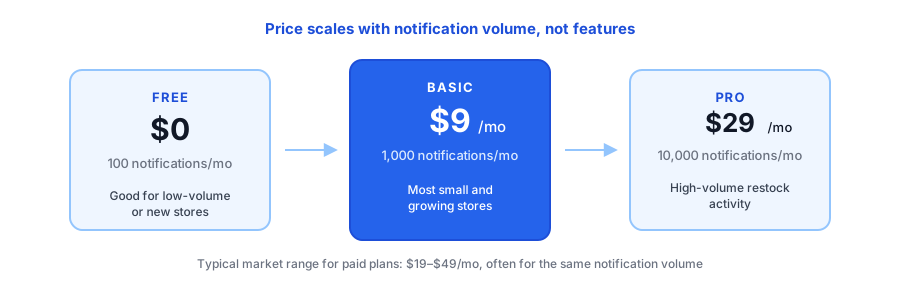
On Griffin's plans, that means $0 for up to 100 notifications a month, $9/mo for up to 1,000, and $29/mo for up to 10,000, which covers most small to mid-sized stores comfortably. Elsewhere in the market, apps with comparable notification volume commonly land in the $19-49/mo range for the equivalent tier, often bundling in SMS or push channels most email-first stores don't end up using.
If you're comparing restock notification app plans across apps, normalize by notification volume first. A $19/mo plan that covers 500 notifications is a worse deal than a $9/mo plan that covers 1,000, even though the second number looks smaller at a glance.
See Griffin's plans and pick the tier that matches your restock volume, starting free.
Install Griffin on ShopifyHidden Costs to Watch For
Beyond the sticker price, a few things quietly push the real back in stock app cost higher than the plan you signed up for:
- Overage fees. Some apps charge per-notification once you exceed your plan's cap instead of prompting a clean upgrade, which can spike a bill during a big restock month without warning.
- Support paywalls. A few apps gate basic setup help behind a higher-priced plan, which matters if your theme needs any troubleshooting during install.
- Developer-dependent installs. Apps that require manual theme code edits often cost more in practice, since you're paying a developer on top of the subscription just to get the widget live, and again every time your theme updates.
- Multi-channel bundles you won't use. If a plan's higher price is mostly covering SMS or push notifications and your store is email-first, you're subsidizing channels that don't move your numbers.
None of these show up in the plan comparison table, so it's worth checking an app's install method and support policy before comparing prices, not just the monthly number.
FAQ
Do I need to pay for a back-in-stock app on Shopify?
Not necessarily. Many back-in-stock apps, including Griffin, offer a free plan that covers a set number of notifications per month. Small or new stores can often run entirely on the free tier before upgrading.
Why do back-in-stock app prices vary so much?
Pricing usually scales with notification volume rather than features. An app that costs $9/mo at one merchant's volume can cost $49/mo elsewhere for the same feature set, just because more emails are being sent per month.
What's a fair price for a Shopify back-in-stock app?
For most small to mid-sized stores, paid plans in the $9 to $29/mo range cover typical notification volume without paying for enterprise features like SMS or multi-channel campaigns you won't use.
Are there hidden costs beyond the monthly plan?
Watch for overage fees once you exceed your plan's notification cap, charges for premium support, and apps that require a developer to install because they need manual theme code edits.
The Bottom Line
Shopify back in stock app pricing looks scattered from the outside, but it almost always comes down to one variable: how many notifications your store sends per month. Start by checking your own restock frequency, see whether a free plan already covers it, and if not, compare paid plans by notification volume rather than sticker price. That's the difference between paying a fair rate and paying for capacity or channels you'll never use.
If you'd rather see actual numbers on your own store, Griffin starts free and scales to $29/mo for high-volume restocking, no theme code edits and no developer needed. Also worth reading if you're still deciding on the right notification approach: Back-in-Stock Notifications vs Waitlists. Install Griffin on the Shopify App Store to check your fit against a real free tier.