Every signup collected all year on sold-out product pages is building toward one specific week: Black Friday and Cyber Monday, when restocks happen fast, inventory moves in and out within hours, and a delayed or dropped notification costs a sale that might never come back around. Most merchants never think about whether their shopify back in stock app black friday cyber monday setup can actually handle that volume until they're already relying on it mid-sale.
The Real Reports: Hidden Caps Discovered at the Worst Time
This isn't a hypothetical risk. Real Shopify App Store reviews describe merchants hitting sending limits specifically during this window: one reviewer found themselves capped at five emails every seven days in the middle of Cyber Monday, with the actual limit turning out to be different from what the app's own materials disclosed. Another reported a full outage during Black Friday where no emails could be sent at all, with the app's developer apologizing after the fact. Neither merchant found this out by reading a pricing page. They found out by hitting the wall during the one week it mattered most.
Why Back-in-Stock Apps Have Volume Limits at All
The sending limit on back-in-stock emails usually isn't arbitrary. A few legitimate reasons show up across different apps: protecting sender reputation, since a sudden massive burst of emails can look spammy to inbox providers and hurt deliverability for every merchant on that sending infrastructure, not just one; plan-tier cost control, where a free tier might allow a modest number of emails a month and paid tiers scale up from there; and in some cases a deliberate cap tied to actual restocked quantity, so the app doesn't notify more people than there are units to sell. None of that makes a cap a red flag by itself. It does make it something worth knowing about well before the week it's tested hardest.
What to Check on Your Plan Before BFCM
A restock alert volume cap bfcm catches merchants off guard almost always traces back to the same gap: nobody checked the specific numbers until volume forced the issue. Worth confirming ahead of time:
- The actual sending limit on your current plan, in writing, not an assumption based on the plan's name or price.
- Whether the cap is a rolling window or a flat ceiling. "5 emails per 7 days" behaves very differently from "5,000 emails per month" once a single week carries most of your yearly restock volume.
- What happens when the cap is hit, queued and delayed, or dropped outright. During a normal week a delay is a minor inconvenience; during BFCM it can mean the notification arrives after the item sold out again.
- Whether upgrading a tier actually raises the relevant cap, rather than just unlocking unrelated features.
Check how Griffin's plans handle your expected restock volume before the busiest week of the year.
Install Griffin on ShopifyPlan for the Dual Surge
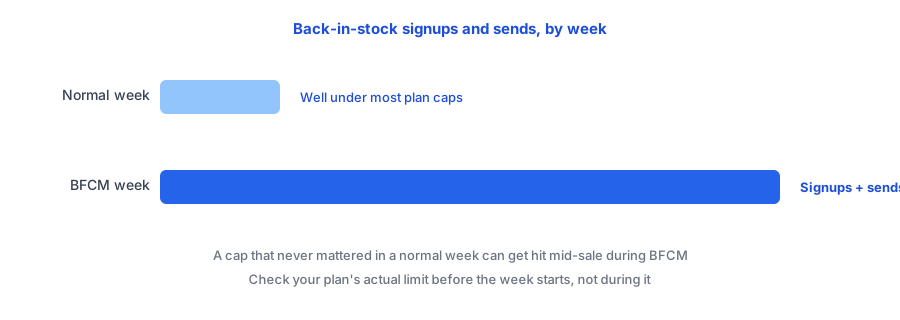
Shopify back in stock holiday traffic creates two surges stacked on top of each other, not one. The first is a surge of new signups, as doorbuster items and flash-sale SKUs sell out and shoppers rush to click Notify Me before moving on. The second, often just hours later, is a surge of actual sends, as those same fast-moving items restock mid-sale and the app tries to notify everyone at once. An app sized comfortably for a normal month's volume can get caught by either half independently, and BFCM tends to deliver both in the same week.
If you already know certain products are likely to sell out and restock more than once during the sale, that's worth factoring into your plan check specifically, since those are the SKUs most likely to push your actual numbers past whatever you've historically needed.
FAQ
Do back-in-stock apps have sending limits during busy periods like BFCM?
Many do, tied to the plan tier, and some merchants have reported hitting unexpected caps specifically during Black Friday or Cyber Monday when signup and send volume both peak at once.
Why would a back-in-stock app limit how many emails it sends?
Reasons include protecting sender reputation from a sudden burst that can look spammy to inbox providers, plan-tier cost control, and in some cases deliberately capping sends to match the quantity actually restocked.
What should I check before BFCM to avoid hitting a cap?
Confirm your plan's specific sending limit, whether it resets as a rolling window or a flat monthly ceiling, and what happens if you hit it, queued and delayed versus dropped entirely, ideally by asking the app's support directly rather than assuming.
Does a higher-priced plan always mean unlimited sending?
Not necessarily. Check the specific numbers rather than assuming paid means unlimited, since some paid tiers still carry a defined monthly or weekly cap.
The Bottom Line
The whole point of a back-in-stock program is to recover sales during exactly the moments demand is highest, and BFCM is the single highest-demand week most stores see all year. A sending cap that never mattered in February can quietly undercut that goal in November, unless it's checked and understood before the sale starts, not discovered mid-way through it.
For the mechanics of handling a restock that's smaller than your waitlist, which often compounds during high-demand weeks, see our post on how limited restocks work with back-in-stock waitlists. Griffin is built to handle real restock volume without hidden surprises. Install Griffin on the Shopify App Store to get set up before your next big sale, free to start.