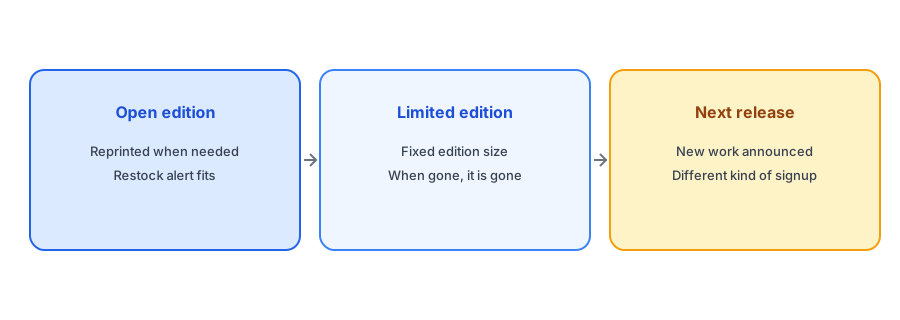
For most stores, a sold-out product is a problem to solve. For art print shops it can be the point. A limited edition of fifty numbered prints is supposed to sell out, and once it does, the scarcity is part of the value. That makes the role of a back-in-stock alert different here. It is a good fit for open-edition prints that can be reprinted, and a poor fit, or at least a different kind of signup, for runs that have ended. Back-in-stock alerts for an art print shop need to respect that distinction, or they promise collectors something that will not happen. We have no reliable figures on this niche, so we reason from how editions work.
Open Editions Are the Natural Fit
Open-edition prints, posters and giclée reproductions can be printed again whenever stock runs low. For these, a restock alert is exactly right: the shopper wants the print, you will reprint, and the alert tells them when. The practical questions are lead time and batch size. Many shops print in runs or on demand, and the time between reprint order and ready stock may be a week or several. Give an honest window, and treat signups as a signal for how large the next run should be. Our guide to alerts for print-on-demand stores covers the on-demand variation.
Limited Editions End, and Should Say So
If an edition is capped, once the last print sells, the edition is closed, and a Notify Me form on that page implies a restock that is not coming. Do not leave it there. Change the page to say "Edition sold out", remove or replace the form and, if you are telling the story of the edition, say how many were made. That honesty is part of the value for collectors. If you hold a few prints back for later or have artist proofs, say clearly what is available and on what terms. Our post on handling subscribers when a product is discontinued explains how to close out existing requests properly.
A Different Signup: Tell Me About the Next Release
Collectors who missed a limited edition often want to hear about the next one. That is a worthwhile list, but it is not the same as a restock alert, and it needs its own consent. Ask for it separately, with clear wording such as "Tell me when the next edition is released", and keep it apart from restock requests. Griffin is a restock alert app, which notifies subscribers when a sold-out variant returns, so for release announcements you would use a different tool or email list. Our guide to using signup data without crossing the consent line explains why they should not be mixed.
Give open-edition fans a way back. Griffin adds Notify Me to each sold-out variant and is free to start.
Install Griffin on ShopifySizes, Papers and Framing Are Variants
Prints come in sizes, paper types and sometimes framed or unframed versions. Each is a variant with its own stock, and a shopper waiting on the large unframed print does not want to hear that the small framed one returned. Griffin ties each signup to the chosen variant and notifies only that variant's subscribers when it comes back. Check that the Notify Me option updates when a shopper switches size; see why the button can disappear on a variant switch. Remember that a limited edition may be split by size, so each size can be its own run.
Collectors, Authenticity and Trust
Collectors care about provenance: edition numbers, signatures, certificates and how the work is packaged. A restock email is a chance to reassure, with a line such as "Each print is numbered and signed" if true, and a note about packaging. Do not add scarcity claims you cannot back up. Honest descriptions matter more in this niche than urgency, and our guide to low-stock messaging without fake urgency applies directly. Our post on alerts for toy and collectible stores covers a related audience.
Writing the Restock Email for a Collector
Name the print, the size and the paper, and say whether this is a reprint from the same plates or file or a new run. Collectors care about that detail. Add a direct link to the right variant, note any limit per customer and mention how the print is packed and shipped. Keep the tone respectful of the work rather than salesy, and do not invent scarcity: if the print is open edition, say so. The honest version is also the more persuasive one with this audience.
A Practical Checklist
- Offer Notify Me on open editions and reprintable prints.
- Mark capped editions as sold out and remove the restock form.
- Offer a separate, clearly worded signup for next releases.
- Give honest reprint windows for open editions.
- Treat each size, paper and framing option as its own variant.
- Keep scarcity claims accurate and avoid invented urgency.
FAQ
Should a limited edition print have a Notify Me form?
Not once the edition is sold out, since it will not return. Replace it with an "Edition sold out" message and, if you like, a separate next-release signup.
Are restock alerts useful for open-edition prints?
Yes. They can be reprinted, so an alert tells subscribers when stock is ready.
Is a next-release signup the same as a restock alert?
No. It announces new work and needs separate consent, so keep it apart from restock requests.
Do sizes and papers need separate alerts?
Yes. Each is a variant with its own stock, and subscribers should hear only about the one they chose.
The Bottom Line
For art prints, know whether the edition can return, and make the alert say so. Griffin is a Shopify back-in-stock app you can install from the Shopify App Store, free to start.