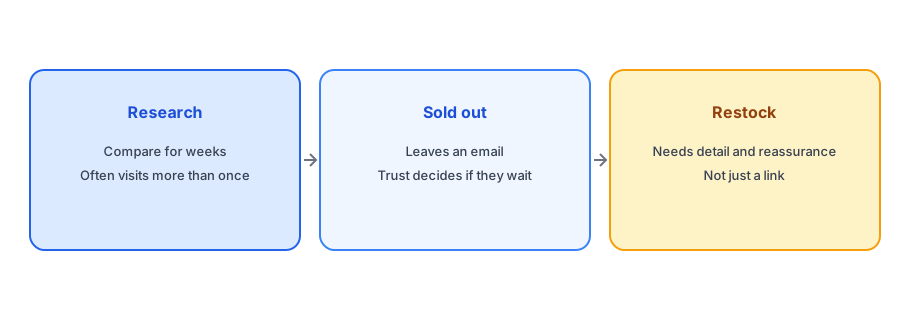
Most advice on restock alerts assumes an impulse: the shopper wanted a product, it was sold out, and a quick email brings them back. That model weakens as the price goes up. Someone considering a high-priced sofa, bike, watch or piece of equipment typically researches for days or weeks, compares alternatives and may visit your page several times before deciding. A sold-out notice interrupts that process, and what you do next determines whether they wait for you. Back-in-stock alerts for high-ticket products need to respect that slower decision. We have no reliable published data on this, so the post reasons from how expensive purchases are made and avoids invented figures.
Trust Decides Whether They Wait
For a cheap item, a shopper may leave an email on a whim. For an expensive one, they leave it only if they trust that the alert will come and that the product will be what they expect. Reassure them at signup: say what you will email about, how long restocks usually take if you know, and that you will not spam them. If you do not know the timing, say so honestly; our replies for "when will it be back in stock?" include wording for uncertain timing. A realistic window builds more confidence than a hopeful date.
Supplier Allocations and Long Waits
Expensive goods often come from suppliers who allocate stock in small batches, which can mean long, uncertain waits. A waitlist can sit for months. During that time, the shopper may buy elsewhere, change their mind or lose interest, and your list quietly decays. Plan for it: review old requests periodically, and consider a short check-in if a wait stretches far beyond what you suggested. Our guide to cleaning up subscriber lists covers how to treat aging requests, and the post on alerts for electronics stores covers allocation-driven restocks.
What the Restock Email Needs to Say
A restock email for a high-ticket product has more to do than a link. The shopper may need to be reminded why they wanted it, so name the exact variant and finish and include the key specifications. Reassure on the things expensive buyers worry about: warranty, delivery method and timing, returns, assembly or installation if relevant and how to contact you with questions. Be clear about quantity: if only one or two units are available, say so, which helps them decide without manufactured urgency. Our post on low-stock messaging without fake urgency applies directly. Keep the email calm and informative rather than pushy.
Give patient buyers a reliable way to hear when it returns. Griffin adds Notify Me to each sold-out variant and is free to start.
Install Griffin on ShopifyA Personal Touch Is Worth It
Because high-ticket subscribers are few and valuable, you can afford a human step. When a long-awaited item arrives, a short personal note from someone on your team, sent to the people who asked about that specific item, can reassure and answer questions. Keep it about the product they asked for, which is within the scope of their request, and do not use it to sell other things. For very high-value items, a quick phone or message offer to answer questions can close a sale that an automated email would not.
Alternatives to Waiting
Some buyers will not wait indefinitely, and some products can be sold ahead of arrival. If you can give a dependable ship date, a preorder or deposit can capture the sale now; our post on back-in-stock alerts versus preorders explains when each fits. If you offer an alternative, be honest about how close it is, as described in our guide to matching alternatives on a sold-out page. For the many shoppers who will still prefer to wait, keep the Notify Me form visible alongside any alternative.
Use Signups to Plan Purchasing
Signups tell you which expensive items to stock deeper, but they also tell you something more subtle: how many people were prepared to wait. With high-ticket items, a handful of signups can represent real revenue, so read counts carefully, and weigh them against the cost of holding inventory. Our waitlist-to-order calculator shows how to turn signups into a cautious quantity.
A Practical Checklist
- Reassure at signup: what you will email, timing if known, no spam.
- Be honest about uncertain waits and review old requests periodically.
- Include specifications, warranty, delivery and returns in the restock email.
- Say how many units are available without invented urgency.
- Consider a personal note for long-awaited, high-value items.
- Offer a preorder or honest alternative for shoppers who cannot wait.
FAQ
Do restock alerts work for expensive products?
Yes, but buyers decide slowly, so the alert should reassure and inform, not just link.
What should a high-ticket restock email include?
The exact variant, key specifications, warranty, delivery and return terms, and how many units are available.
What if the wait is very long?
Be honest about the uncertainty, review old requests and consider a short check-in.
Should I offer a preorder instead?
Only if you can give a dependable ship date. Otherwise a restock alert is the safer promise.
The Bottom Line
For expensive products, the restock alert is one step in a slow decision, and trust and detail matter more than speed. Griffin is a Shopify back-in-stock app you can install from the Shopify App Store, free to start.