Every merchant knows stockouts cost money, and almost none know how much. Industry articles throw around enormous figures, but nearly all of them are estimates published by vendors, and they say nothing about your store. The better question is smaller and answerable: if this product is sold out for a week, what do I miss, and how much of it could I win back? The out of stock lost sales calculator below uses only your numbers. Every value in it is an example you should replace.
The Calculator
The Formula Behind It
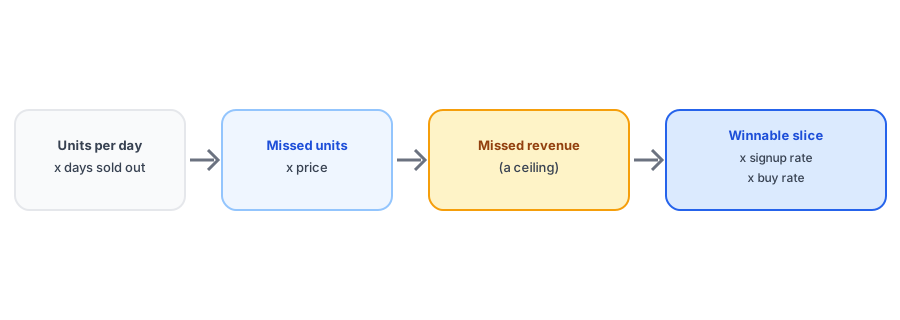
The calculation has two halves. The first estimates the damage: units sold per day times days sold out gives the demand you could not serve, and multiplying by price gives the revenue attached to it. The second estimates what a restock alert might return: the share of missed buyers who would sign up, times the share of signups who buy when told, times price. In plain terms: missed revenue = units per day x days sold out x price, and recovered revenue = missed units x signup rate x buy rate x price.
A Worked Example
Take the example values above, which are illustrations and not benchmarks. A product that sells 10 units a day at 40 each is sold out for 7 days in a month. That is 70 units and 2,800 in revenue you could not serve. If one in five of those missed buyers would leave an email address, that is 14 signups, and if three in ten of them buy when told, that is about 4 orders and 168 in revenue, or 84 at a 50 percent margin. Small numbers for one product, but a store with dozens of products and regular stockouts can add up quickly, and the alert costs the same whether the restock is small or large.
Why the Number Is a Ceiling, Not a Forecast
The first half assumes shoppers keep arriving at your normal rate while the product is sold out, and that all of them would have bought. Neither is quite true. Some visitors arrive because the product was in stock and promoted, and traffic often drops once a product is unavailable. Some would have bought something else. Some of the demand you appear to miss simply moves to another retailer rather than disappearing, which is why we do not quote large industry totals here. Use the missed revenue figure as an upper bound and the recovery figures as an estimate to refine.
Start collecting the real numbers. Griffin's free plan covers 100 notifications a month and reports recovered revenue.
Install Griffin on ShopifyReplacing Guesses With Data
The two recovery inputs are the shakiest, and they are also the ones you can measure. After a few restocks, you will know how many shoppers signed up for each product and how many bought, so you can replace the guesses with your own rates. Our guide to measuring revenue from restock alerts explains how orders are matched to alerts and why different tools disagree, and our post on tracking customer demand on out-of-stock products shows how to read waitlist sizes.
What to Do With the Result
- If missed revenue is small, the cheapest fix may be a free plan; see what a free plan covers.
- If it is large, look at the cause. Slow reordering is an inventory problem, not an alert problem.
- Compare recovered profit with what an app costs; our pricing guide shows typical ranges.
- Work through the options in nine things to do when a product is out of stock.
FAQ
How do I calculate lost sales from an out-of-stock product?
Multiply the units you normally sell per day by the number of days the product was sold out, then multiply by the price. That gives the demand you could not serve, as an upper estimate.
Is that estimate accurate?
It is an upper bound. It assumes shoppers keep arriving at the normal rate while the product is sold out and that every one of them would have bought. Treat it as a ceiling and use the recovery inputs to estimate what is realistically winnable.
What share of lost sales can a restock alert recover?
It varies a lot by product and shopper. Only some visitors will sign up, and only some of those will buy when notified. The calculator asks you to enter your own assumptions, and your real numbers after a few restocks will beat any guess.
Why not use industry statistics for lost sales?
Headline figures are mostly estimates published by vendors and are rarely specific to a store like yours. Your own sales history is more reliable for deciding whether to act.
The Bottom Line
You do not need an industry statistic to decide whether stockouts matter. Enter your own sales, see the ceiling, then estimate the slice a restock alert could win back and refine it with real data. Griffin is a Shopify back-in-stock app you can install from the Shopify App Store, free to start.